Automated keyword clustering for large-scale websites: A practical guide
A practical guide to implementing automated keyword clustering for large-scale sites, balancing accuracy, scalability, and workflow efficiency with AI-powered tools.
Automated keyword clustering for large-scale websites
When your site spans tens of thousands of pages, a manual keyword taxonomy isn’t just tedious — it’s a bottleneck that blocks growth. You may have dozens, even hundreds, of competing topics per root segment. The decision is simple: you need a scalable, repeatable process that preserves quality while accelerating output. This guide walks you through practical approaches, concrete workflows, and the SerpX tools that make automated keyword clustering work at scale.
The scaling challenge for keyword clustering
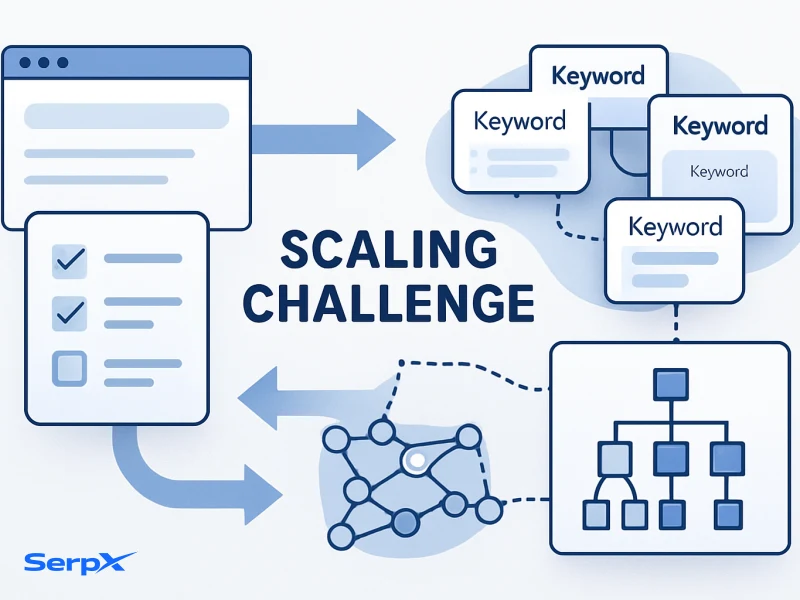
Imagine you run an e-commerce platform with thousands of product pages, plus millions of landing pages across categories. Every week, new products, seasonal pages, and evergreen guides flood your editorial calendar. The old approach — hand-tiling keyword groups, patching gaps, and hoping cannibalization stays under control — breaks down. You risk duplicate topics, misaligned intent, and missed opportunities because a human can’t keep up with the data velocity.
Key pain points you’ll encounter without automation:
- Keyword overlap that cannibalizes rankings
- Fragmented topic taxonomies that confuse content teams
- Slow iteration cycles that push page updates and content refreshes out of sync
- Inconsistent signaling from intent shifts across markets and languages
The decision is not whether to cluster keywords, but how to do it at scale without sacrificing accuracy. The right approach blends automation for scale with governance for quality.
Try AI-powered keyword clustering workflows with our AI SEO Tools to accelerate taxonomy creation and maintain guardrails.
How automated keyword clustering works at scale
From an SEO operations perspective,
The core idea is to reduce a sprawling keyword universe into a structured, navigable taxonomy that aligns with content goals. A strong automated clustering setup typically combines three layers:
- Semantic representation: transform keywords into vector embeddings that capture meaning beyond exact phrases.
- Clustering logic: group semantically related terms into topic clusters, optionally with hierarchical zoning (topic > subtopic).
- Quality gates: enforce thresholds for coverage, intent alignment, and page-level relevance before content plans commit to production.
Practical tips from a working setup:
- Start with a seed set of core topics aligned to your business goals, then expand using algorithmic similarity rather than arbitrary keyword matching.
- Use confidence thresholds to prevent over-fragmentation. It’s better to have 120 high-signal clusters than 500 fuzzy ones.
- Incorporate intent signals (informatives, navigational, transactional) to guide how clusters map to content formats (guide pages, category pages, product pages).
In practice, you’ll often iterate through a loop: extract keywords, cluster, review a subset, adjust thresholds, then re-cluster. Automation handles scale; humans handle nuance and governance.
Unlock gaps quickly with our Keyword Gap Tool to identify terms your competitors rank for but you don’t yet target.
Choosing the right clustering approach for large sites
There are several viable approaches. Each has trade-offs between speed, quality, and maintainability. For large sites, a hybrid often performs best:
- Top-down taxonomy: start from high-level topics and branch into subtopics. Pros: strong governance, clear taxonomy. Cons: can be slow to bootstrap.
- Bottom-up clustering: let algorithms discover groups from data; humans label them. Pros: scales well, discovers hidden themes. Cons: requires curation gates.
- Hybrid: combine top-down anchors with bottom-up clustering and post-hoc refinement. Pros: balance of control and discovery. Cons: more setup complexity.
Common algorithms you’ll see in serious SaaS and ecommerce setups include hierarchical clustering, K-means variants with adaptive k, and graph-based clustering that prioritizes strongly connected terms. For large catalogs, a staged approach often wins: quick, broad clustering to establish the skeleton, then fine-tuning on the critical segments before deeper, long-tail work.
For benchmarking, explore our Competitor Keyword Research Tool to map your clusters against market leaders.
SerpX workflow for large-scale keyword clustering
One thing many teams miss:
Here’s a concrete, repeatable workflow you can adopt with SerpX tools. It’s designed to stay effective as your site grows and markets expand.
- Ingest and normalize data: import your current keyword lists, site pages, and search console data. Normalize for language, stemming, and locale where needed.
- Generate embeddings: convert keywords into semantic vectors to capture intent and context, not just matching strings.
- Initial clustering pass: run a scalable clustering pass to form topic groups. Use a broad similarity threshold to avoid over-fragmentation.
- Review and label: a small editorial team reviews clusters to assign topic labels and decide tiering (primary topics, subtopics, tail topics).
- Map to content assets: align clusters with landing pages, category pages, or hub pages. Create a content plan that covers gaps and improvements.
- Establish governance: set guardrails on how new keywords join clusters, how thresholds are tuned, and how often you re-cluster.
- Iterate weekly: re-cluster after new data, refine thresholds, and publish updates to content calendars.
With SerpX, you can automate the heavy lifting while keeping a human-in-the-loop for taxonomy integrity. The key is to codify your governance early and keep a clear change log so teams understand why clusters shift over time.
Keep content aligned with intent using our AI Content Detector and ensure quality across clusters.
Trade-offs: clustering methods at scale
Choosing a clustering method is a trade-off between speed, interpretability, and precision. The table below contrasts common approaches you’ll consider in a large-scale context.
| Method | Strengths | Weaknesses | Best Use |
|---|---|---|---|
| Top-down taxonomy | Clear governance, scalable visibility | Long bootstrap time, risk of rigidity | New sites, strict content hierarchies |
| Bottom-up clustering | Discovery of latent topics, scalable | Requires strong curation gates | Large catalogs with evolving themes |
| Hybrid approach | Best balance of control and discovery | Setup complexity, ongoing governance needed | Mature sites with broad product ranges |
| Graph-based clustering | Captures relationships between terms | Complex to implement and maintain | Very large, interconnected topic maps |
Practical takeaway: start with a hybrid approach for a scalable taxonomy, then layer in graph-based signals for cross-link opportunities and inter-topic connections. Always couple the method with clear governance and a review cadence.
Experiment with free tools from Free SEO Tools to pilot clustering on a subdomain or product category.
Implementation checklist: getting going in 30 days
Here’s the practical reality:
Use this pragmatic checklist to bootstrap automated keyword clustering within a month. It’s designed to be actionable for product marketing, SEO, and content leadership.
- Define success criteria: target metrics like reduced cannibalization, faster content planning, and a measurable improvement in cluster coverage.
- Assemble a governance team: appoint owners for taxonomy, language/localization, and content mapping.
- Collect data sources: surface keywords from search console, site search, and existing keyword lists; normalize variants.
- Run the initial clustering sweep: generate topic clusters with validated thresholds and seed labels.
- Editorial labeling: assign topic labels and decide which clusters map to hub pages, category pages, or product pages.
- Content mapping: create a prioritized content plan that addresses gaps and strengthens authority around core topics.
- Establish gates: implement gates for new keywords to join clusters; require editorial review for new topics.
- Review and iterate: run a weekly or biweekly cycle to re-cluster on data updates and publish improvements.
Ready to scale? Explore SerpX pricing and start with a free trial to see clustering in action.
Common mistakes to avoid
Even with automation, some missteps are human. Here are frequent pitfalls and how to sidestep them.
- Over-clustering: too many tiny clusters create noise and dilute intent signals. Constantly prune and collapse when necessary.
- Ignoring intent signals: clustering only by keywords loses the user goal behind queries. Tie clusters to defined user intents.
- Failing to govern changes: without a changelog and versioning, clusters drift and teams lose trust.
- Skipping content mapping: clusters without concrete page plans stagnate; map every cluster to content once established.
- Underestimating localization: multilingual audiences require separate taxonomies or clearly defined translations to avoid cross-language confusion.
Frequently Asked Questions
One thing many teams miss:
Why automate keyword clustering on large sites?
Automation scales to thousands of keywords and pages, preserves consistency, and accelerates content planning. It also helps enforce a living taxonomy that adapts to new data and market shifts.
How do I avoid cannibalization after clustering?
Set clear topic ownership, map clusters to distinct hub and category pages, and use content depth and intent alignment to differentiate similarly themed pages. Regular audits help catch drift early.
What data sources should feed the clustering process?
prioritized sources include search console query data, site search analytics, existing keyword lists, and competitive landscape signals. Normalize data to reduce noise from synonyms and locale variants.
How often should clusters be refreshed?
Typically, run a refresh cycle monthly for mature sites and biweekly for fast-moving catalogs. Tie refresh frequency to data velocity and product launches.
Which SerpX features are essential for this workflow?
Key features include AI-driven keyword research, the Keyword Gap Tool, and the ability to map clusters to content assets. These enable scalable, repeatable processes with guardrails.
Is automation enough, or do we still need editorial oversight?
Editorial oversight remains crucial. Automation handles scale and consistency, but humans validate taxonomy, intent alignment, and content strategy to avoid structural mistakes.
Related Articles
- What Are Keyword Gaps? Beginner Guide — foundational concepts for gap analysis and opportunity discovery.
- Keyword Gap Analysis: Find Missing Opportunities — practical methods to compare against competitors.
- AI SEO in 2026: Complete Guide to Ranking Faster with Automation — broader context for AI-enabled SEO programs.
Interested in taking the next step with SerpX? Review our pricing and start a test drive today.
Join thousands of marketers using SerpX to scale keyword clustering. Get started with a free account.
Apply these ideas with SerpX tools
Turn insights into action with practical workflows for keyword research, competitor analysis, backlink review, and SEO planning.