Future of SEO: Generative Engine Optimization (GEO)
Exploring GEO—how generative AI reshapes keyword research, content workflows, and technical SEO with practical guidance and SerpX-driven playbooks.
Future of SEO: Generative Engine Optimization (GEO)
If you’re responsible for organic growth in a competitive niche, you’ve felt the bottleneck: content velocity is too slow, keyword opportunities are buried in hours of manual research, and technical fixes cascade into days of work. GEO, or Generative Engine Optimization, is not a hype term. It’s a disciplined approach that combines AI-assisted generation with rigorous SEO guardrails to accelerate discovery, content creation, and technical alignment without compromising quality. In this guide, you’ll find practical decisions, trade‑offs, and concrete steps you can take today with SerpX as your coordinator.
What GEO Really Is and Why It Matters
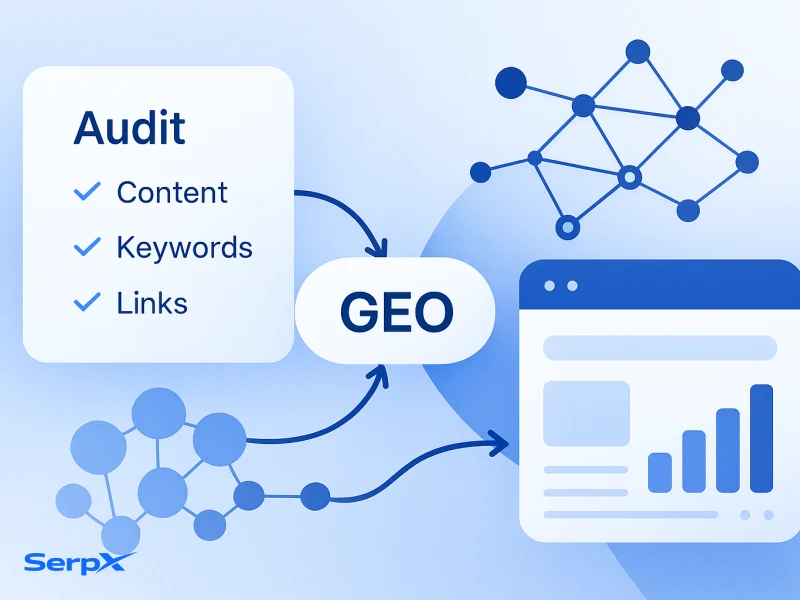
GEO is a framework, not a single tool. It weaves generative capabilities into core SEO processes with three guardrails: intent alignment, quality control, and governance. Think of GEO as a way to:
- Identify high-potential topics faster by analyzing large topic graphs and user intent signals.
- Draft content at scale while ensuring relevance, accuracy, and on‑page optimization.
- Audit technical signals at pace, catching crawl, indexation, and data quality issues before they become visible problems.
Practically speaking, GEO helps teams move from long cycles of research and drafting to shorter, repeatable sprints. For context, see how AI-driven playbooks have evolved for competitive niches in 2026, and adapt lessons to your own niche using guardrails and clearly defined success criteria. If you want a head start, our article AI SEO strategies for competitive niches 2026 offers guardrails and workflow examples you can adapt to GEO. AI SEO strategies for competitive niches 2026
Soft CTA: Curious about tooling options? Explore AI SEO Tools to begin shaping your GEO workflows today.
Generative Keyword Research: Discovery at Scale
One thing many teams miss:
Traditional keyword research can feel like detective work with a slow payoff. GEO flips that by combining AI-assisted clustering, intent-inference, and scalable keyword gaps. Instead of chasing a handful of obvious terms, you build a spectrum of topics around user intent, then map them to content opportunities, internal linking, and ranking signals. The practical outcome is a prioritized list that respects search intent and content feasibility.
What this looks like in practice:
- Run automated keyword clustering across large domains to identify topical silos and gaps.
- Use intent signals (informational, navigational, transactional) to surface opportunities with realistic conversion potential.
- Cross-check with SERP features and competition to set target pages and content formats.
For a hands-on guide on scalable keyword clustering, see Automated keyword clustering for large-scale websites: A practical guide Automated keyword clustering for large-scale websites. You can also compare GEO-driven keyword opportunities against traditional methods with our Competitor Keyword Research Tool.
Internal references you may find useful as you implement GEO in your research cadence: Keyword Research Guide: How to Find High-Value Keywords in 2026 and What Are Keyword Gaps? (Beginner Guide + Examples).
Mini-table: Traditional vs GEO-driven keyword research
| Aspect | Traditional SEO | GEO with SerpX |
|---|---|---|
| Discovery Speed | Slower, manual research cycles | Faster, AI-assisted clustering and intent inference |
| Scope | Limited by teams and time | Broad topic graph with guardrails |
| Quality Control | Post-hoc refinement | In-process checks and guardrails |
| Output | Lists of keywords and rough intent | Structured topics, gaps, and content briefs |
CTA: If you’re ready to test GEO-enabled keyword discovery, try our Keyword Gap Tool to surface overlooked opportunities.
Generating Content with Guardrails
Content generation is the most visible aspect of GEO. The goal isn’t to replace humans but to accelerate them while preserving voice, accuracy, and brand standards. Here are practical guardrails to implement in one sprint:
- Define exact content briefs with target keywords, user intent, and page-level goals before drafting.
- Set tone, length, and accuracy thresholds that align with your brand guidelines.
- Require human review at key steps: outline approval, factual checks, and final edits.
- Use structured data and on-page signals to guide AI output (title, meta description, headers, internal links).
Practical example: generate a 1,200-word pillar page outline on a broad topic, then hand off to a human writer to complete, followed by AI-based optimization checks. This approach balances speed with quality. If you want to compare approaches, see SerpX’s work with programmatic content in Best AI SEO Agents for Programmatic Content Best AI SEO Agents for Programmatic Content.
For content optimization automation, consider AI Content Optimization: How to Rank Faster with Smart Automation AI Content Optimization.
CTA: Explore AI Content Tools on our platform to streamline outline-to-live-page workflows. AI SEO Tools can help you set guardrails for content generation.
Technical SEO and GEO: Signals, Structure, and Compliance
Here’s the practical reality:
GEO doesn’t bypass technical SEO; it elevates it. The most reliable GEO outcomes come when technical foundations are solid and AI-driven content aligns with crawlability, indexing, and data quality best practices. Key considerations include:
- Structured data and semantic signals that reflect the topic network you’re building.
- Crawl efficiency, XML sitemaps, and canonicalization that prevent content duplication from AI output.
- Quality signals: original research, cited sources, and transparent author attribution to protect trust.
- Audits and guardrails powered by AI to surface technical issues before they impact rankings.
For a practical starter, our AI SEO Audit Checklist helps teams prioritize issues with an AI-assisted lens. See AI-Powered Technical SEO Audit Checklist: A Practical Guide AI-powered Technical SEO Audit Checklist. If you’re evaluating tooling stacks, Alternatives to Moz for technical SEO auditing: a practical guide offers solid perspective Alternatives to Moz.
Software options to inspect include the interplay between keyword gaps and technical signals. For a practical workflow, pair the Keyword Gap Tool with Backlink Checker to validate authority implications (Backlink Checker).
Trade-offs, Risks, and Governance
GEO introduces speed, but it also introduces new risk vectors. Over-automation can erode nuance, damage brand voice, or produce inaccurate facts if guardrails aren’t enforced. Practical governance includes:
- Planned human-in-the-loop checkpoints at briefs, outlines, and final edits.
- Clear attribution policies for AI-generated or AI-assisted content.
- Documentation of guardrails: what gets auto-generated, what gets human reviewed, and who signs off.
- KPIs tied to both speed and accuracy: time-to-publish alongside accuracy and click-through quality.
Best for teams that operate in highly regulated industries or where misstatements could harm the brand. Not best for projects where you require extremely nuanced creative direction without human oversight.
CTA: If you’re evaluating GEO maturity, start with a low-risk pilot using the Backlink Checker and Keyword Gap Tool to validate results. Backlink Checker
SerpX Workflow for GEO: A Practical Adoption Path
One thing many teams miss:
SerpX isn’t just a toolset; it’s a repeatable workflow. Here’s a practical path you can follow this quarter:
- Define a GEO objective: a topically aligned pillar page with a target ranking and measurable engagement.
- Kick off keyword discovery with automated clustering across your site and competitors.
- Draft a content outline and set guardrails: intent match, length, sources, and internal linking plan.
- Generate draft sections using AI, then route to human editors for factual checks and tone adjustments.
- Run a technical audit with an AI-powered checklist to fix crawl and indexation issues before publish.
- Publish, monitor rankings, and iterate based on SERP features and user signals.
In practice, this reduces cycle times while preserving quality. To begin the workflow, explore our AI SEO Tools for integration that supports both keyword discovery and content generation. AI SEO Tools
As you scale GEO, consider coupling with the Keyword Gap Tool for ongoing opportunity discovery and the Competitor Keyword Research Tool for monitoring shifts in your space. Keyword Gap Tool and Competitor Keyword Research Tool
CTA: See how GEO fits your needs with transparent pricing. Pricing or Register to start a trial.
GEO Implementation Checklist
- Align GEO objectives with business goals and define success metrics.
- Set guardrails for content generation (tone, accuracy, length, citations).
- Establish a human-in-the-loop review process for outlines and final drafts.
- Integrate AI-driven keyword discovery with content briefs and internal linking plans.
- Run technical audits to fix crawlability, indexing, and data quality issues before publishing.
- Monitor performance and adjust guardrails based on real-world results.
- Document workflows and governance for scale and knowledge transfer.
Soft CTA: Quick-start guide available via AI SEO Tools to accelerate GEO adoption. AI SEO Tools
Common GEO Mistakes to Avoid
One thing many teams miss:
- Relying solely on AI-generated content without human validation.
- Ignoring user intent shifts over time; content becomes stale quickly.
- Underinvesting in technical SEO and data quality signals.
- Failing to document guardrails and governance, leading to inconsistent outputs.
Proactively testing guardrails with small pilots can reveal weaknesses before broad rollout. For a broader architectural view, read about SerpX’s AI content strategy in SerpX AI vs Jasper: Which is better for SEO content? SerpX AI vs Jasper.
Related Articles
- SerpX vs Semrush: A Full, Honest Comparison (2026)
- SerpX vs Ahrefs: Which SEO Tool Is Better in 2026?
- AI Content Optimization: Smart Automation
Frequently Asked Questions
One thing many teams miss:
What exactly is Generative Engine Optimization (GEO)?
GEO is a framework that blends AI-generated content and analysis with rigorous guardrails, governance, and human review to accelerate SEO workflows without sacrificing quality or accuracy.
How is GEO different from traditional SEO?
Traditional SEO relies largely on manual research and writing workflows. GEO introduces AI-assisted generation and automated checks to scale discovery, content, and technical audits while maintaining accountability and brand safety.
What are the best guardrails for GEO?
Guardrails include: explicit content briefs, tone and length constraints, required citations for factual claims, a human review stage, and technical checks before publishing.
Which SerpX tools are most relevant to GEO?
Key tools include AI SEO Tools for end‑to‑end workflows, the Keyword Gap Tool for discovery, and the Backlink Checker for authority validation. See also the Competitor Keywords tool for monitoring shifts.
How should I measure GEO success?
Track speed (time-to-publish), accuracy (fact-check pass rate), engagement (CTR, time on page), and ranking stability across target topics. Combine with traditional KPIs like qualified traffic and conversions.
Is GEO suitable for all industries?
GEO tends to work best where content can be structured around verifiable information and clear user intent. Highly regulated or brand-sensitive sectors require stricter governance and more human oversight.
Apply these ideas with SerpX tools
Turn insights into action with practical workflows for keyword research, competitor analysis, backlink review, and SEO planning.