AI SEO strategies for competitive niches 2026
Navigate crowded markets with practical AI-driven SEO playbooks for 2026. This guide delivers actionable steps, guardrails, and real-world workflows to outrank incumbents in competitive niches.
AI SEO strategies for competitive niches 2026
In crowded markets, the smallest edge is the difference between page one and a fleeting ping of traffic. You’re balancing a tight budget, evolving search intent, and a content backlog that grows faster than you can optimize it. This guide offers pragmatic, field-tested AI-driven strategies to win in competitive niches in 2026—without burning through every resource.
Pro tip: Scale with AI-powered SEO workflows that keep quality in check.
Explore AI SEO ToolsOpportunity: Use keyword gap insights to prioritize high-impact pages.
Try Keyword Gap ToolBenchmark: Compare your approach against peers with SerpX competitor research.
Check Competitor KeywordsPractical pain point: competing niches and speed to impact
Imagine a SaaS brand competing in analytics tooling. You’ve got a catalog of 1,800 keywords, but the ranking timeline for product pages is unpredictable and your content velocity is limited by reviews and approvals. The problem isn’t just finding keywords; it’s aligning a scalable content system with guardrails that keep quality from drifting while you push volume. The decision point: adopt AI-driven workflows that can be scaled responsibly, or keep scrambling through manual checks that stall growth.
In 2026, the right move isn’t chasing every shiny AI feature. It’s building a repeatable, audited process where AI handles repetitive work—research, clustering, outlining—while humans focus on strategic topics, edge cases, and final quality control. The result is not magic; it’s discipline with intelligent automation.
AI foundations in 2026: what’s realistic to expect
One thing many teams miss:
Use AI where it adds signal without letting it erode accuracy. Realistic expectations include rapid keyword discovery, scalable content outlining, and automated auditing—but with strict guardrails: accuracy checks, tone controls, and a human-in-the-loop for critical pages. When you design around guardrails, AI becomes a force multiplier rather than a risk factor.
Two practical anchors help: first, separate discovery from optimization. AI excels at discovery (finding opportunities, clustering topics) and at drafting scaffolds (outlines, meta templates). Second, embed a lightweight audit layer. Tools like AI-powered technical SEO audits demonstrate how automation can catch crawlability and indexing gaps early, preventing expensive rework later. For broader context, see our AI SEO in 2026 guide.
AI-driven keyword research & clustering for competitive niches
In crowded topics, semantic nuance matters. Start with seed ideas, then expand into clusters that map to user intent. AI-assisted clustering can reveal hidden topic families you’d miss with manual methods, but you must monitor quality and maintain topic relevance. A practical approach is to run a two-pass process:
- Seed your core pages with a human-approved list of focus intents (informational, navigational, transactional).
- Let AI generate expansive clusters, then prune them against a human-curated taxonomy.
- Validate clusters using historical performance signals and competitor benchmarks.
For large-scale sites, automated keyword clustering becomes essential. See our practical guide on automated keyword clustering for large-scale websites for a hands-on blueprint.
Along the way, reference material helps: our Automated keyword clustering for large-scale websites demonstrates a scalable workflow that balances accuracy and efficiency. To deepen keyword research, consult our Keyword Research Guide for high-value keywords and intent signals.
Content workflows & guardrails: quality at scale
That matters because
Automation should accelerate, not hollow out, content quality. Build a guardrail system that integrates AI-generated outlines with editor-approved templates, tone and E-E-A-T checks, and a final human review for pivotal pages. Practical workflows:
- Outline-first with AI, then push to editors for validation and enrichment.
- Run AI-assisted checks on structure, headings, and internal linking; flag anomalies for human review.
- Maintain a content library with documented intents, topic boundaries, and success metrics.
Scale your content production with AI while protecting quality. For a broader playbook, see Scaling Content Production Using AI SEO Tools.
When validating content, pair AI with reputation-aware signals. The combination of AI-generated outlines and editorial judgment helps ensure accuracy, voice, and user value across competitive pages.
Competitive niches playbook: tactics vs trade-offs
The playbook for competitive niches blends opportunity discovery with disciplined execution. Key tactics include:
- Target long-tail, intent-rich pages that incumbents overlook, then expand with related clusters.
- Prioritize pages with high impact-to-effort ratios using keyword gap insights.
- Balance optimization with content freshness—rankability can hinge on a steady cadence of updates and new angles.
Guardrails matter here. Relying solely on AI-generated ideas without human validation can produce hollow content. Use the Keyword Gap Tool to identify and prioritize gaps that align with your existing authority and user intent. For a thorough comparison of tools in this space, consider our SerpX vs Semrush piece.
SerpX workflow: practical steps you can take today
One thing many teams miss:
This is where the rubber meets the road. A practical SerpX workflow brings together discovery, clustering, content, and measurement in a repeatable loop:
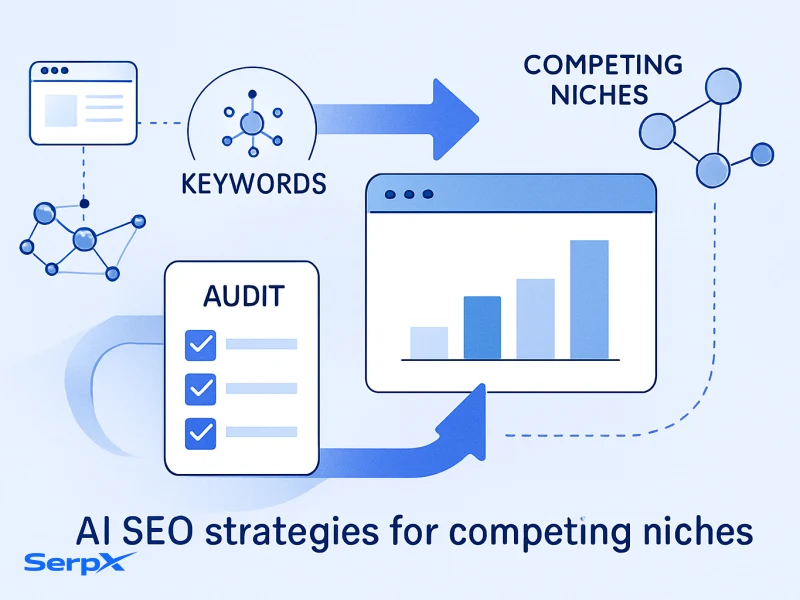
- Audit: run a quick site-wide AI-assisted audit to surface crawl/structure issues and content gaps. Use the AI-powered audit checklist for speed.
- Plan: map clusters to content topics and assign owners. Create clear intent targets for each page type.
- Create: generate outlines and draft content with AI, then enrich with human input for authority pages.
- Optimize: optimize on-page elements, internal linking, and schema markup; apply guardrails to avoid drift.
- Measure: monitor rankings, traffic, and engagement; feed results back into clustering and briefs.
- Iterate: prune underperforming topics and scale successful patterns across the site.
Running this loop with SerpX’s tools helps maintain focus on high-use opportunities while keeping quality in check. See the AI-powered audit checklist for a practical starting point.
Quick comparison: AI-assisted vs manual vs full automation
| Aspect | Manual / Rule-based | AI-assisted | Fully AI-driven automation |
|---|---|---|---|
| Speed to insight | Slow; relies on human bottlenecks | Fast; AI surfaces opportunities quickly | Very fast; continuous discovery and drafting |
| Quality control risk | High if process is inconsistent | Moderate; guardrails reduce drift | Higher risk without strong governance |
| Scalability | Limited by human bandwidth | High; scalable templates and prompts | Requires rigorous governance to stay reliable |
| Data requirements | Low-to-moderate; relies on manual signals | Moderate; benefits from structured data | High; needs clean data pipelines |
| Best use case | Small, well-defined topics | Mid-scale, diverse topics with guardrails | Large-scale programs with strong governance |
Checklist for 2026 AI SEO in competitive niches
This becomes a problem when
- Define top 5–7 niche-specific intents and map to content types.
- Run AI-driven keyword discovery within clear boundaries (topic families, not picking random terms).
- Establish guardrails for quality: editorial standards, tone, and factual checks.
- Implement an AI-assisted outline workflow with human review on key pages.
- Set up a measurement frame: rankings, traffic, engagement, and conversions per topic cluster.
- Regularly prune low-impact topics and scale winning patterns across the site.
- Keep technical SEO audits integrated in your cadence; fix crawl and indexing issues promptly.
- Maintain a content backlog and a calendar that aligns with product launches and seasonality.
Frequently Asked Questions
What makes AI SEO different in competitive niches?
In competitive niches, AI shines by accelerating discovery, structuring topic families, and maintaining consistency across a large content program. The key is guardrails and human validation for critical pages.
How do I start without risking content quality?
Begin with a small pilot: outline-driven AI drafting, with a human reviewer for the first 5–10 priority pages. Establish a weekly review cadence and integrate a content quality checklist.
Which metrics matter most for competitive niches?
Prioritize relevance, intent alignment, click-through rate, dwell time, and qualified traffic growth. Track topic-level impact over time to avoid chasing vanity metrics.
Should I use AI for all content?
No. Reserve AI for discovery, outlines, and non-critical drafts. Reserve human expertise for cornerstone content, case studies, and pages where accuracy and authority are essential.
How do I avoid keyword stuffing with AI?
Use intent-based clustering, enforce strict density/semantic guidelines, and run regular on-page quality audits. The aim is natural language that answers user questions clearly.
What role does SerpX play in this process?
SerpX provides AI-enabled keyword clustering, content outlining, and automated audits, coupled with human-in-the-loop workflows to keep quality high and scale sustainable.
Apply these ideas with SerpX tools
Turn insights into action with practical workflows for keyword research, competitor analysis, backlink review, and SEO planning.