Scaling Content Production Using AI SEO Tools
Scale content production with AI-driven SEO tools using practical workflows, guardrails, and measurable checks to protect quality while boosting output.
Scaling Content Production Using AI SEO Tools
Pain Point Scenario
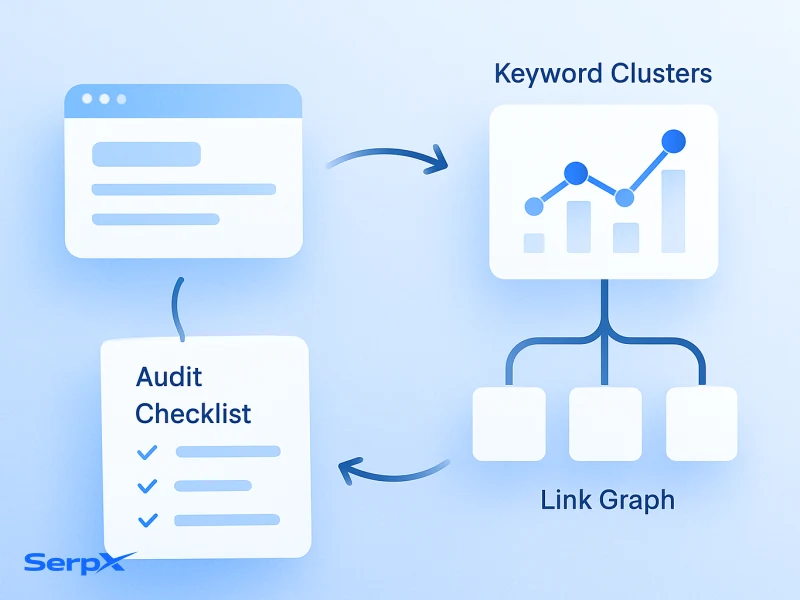
You're a growth-focused SaaS team trying to publish 20 to 30 high-quality articles per month. The wheels spin fast: keyword research, outlines, drafts, optimization, and reviews. Yet quality slips, topics overlap, and publishing cadence slips. You feel pulled between speed and accuracy, risking cannibalization, thin coverage, and random keyword experiments that burn budget. The practical question isn’t whether to automate—it’s how to automate without burning credibility.
Options exist: hire more editors, buy more tools, or lean on AI. The right path isn’t a single tool, but a disciplined workflow that uses AI to accelerate the boring bits while keeping human QA where it counts. If you can design a repeatable process, AI becomes a force multiplier rather than a risk multiplier.
Tip: for broader context on AI-led SEO in 2026, explore practical programmatic strategies in our AI SEO guide. AI SEO in 2026: Complete Guide
Why AI for Content Scaling
This becomes a problem when
AI shines when you need breadth without sacrificing relevance. With smart prompts, AI can generate topic briefs, draft outlines, and even first-pass content that respects intent signals. The trick isn’t “set it and forget it” but applying guardrails—tone, length targets, semantic enrichment, and quality checks—that convert velocity into value.
In practice, AI should handle the repetitive, high-volume parts of the workflow while human editors focus on nuance, credibility, and polish. A well-designed AI-assisted flow reduces cycle time per piece and increases consistent output, enabling you to cover more topics with less drift from your topical authority center.
If you’re curious about how AI content optimization can scale your workflow, check out practical insights from our AI content optimization playbook. AI Content Optimization: Smart Automation
Designing a Scalable Content Workflow
Think in stages: research, briefs, outlines, drafting, editing, optimization, and publishing. The cohesion happens when each stage has a clear owner, guardrails, and checkpoints. Here’s a concise blueprint that pairs human oversight with AI execution:
- Define intent and audience for each topic. Align on search intent, value propositions, and monetization signals.
- Run keyword research with AI sparingly, then validate gaps with a structured gap analysis. Use a tool to surface opportunities and map them to topics.
- Create a brief template that includes target keywords, user questions, and required sections. Feed it to the AI to produce outlines and first drafts.
- Draft and semantic enrichment: generate sections, add internal links, and incorporate multimedia cues. Apply editorial constraints (tone, length, and formatting).
- QA and optimization: run content quality checks, ensure readability, and optimize for on-page SEO signals without sacrificing narrative quality.
- Publish, then monitor performance and iterate on the next set of topics using learnings from the first wave.
Programmatic keyword research and gap analysis are central. Our approach advocates a pipeline that uses AI for breadth and speed, but still relies on human judgment to validate opportunities and theme cohesion. For a practical intro on AI-driven keyword research in 2026, see our guides on AI keyword research.
Tool Portfolio and Integration
That matters because
Choose a practical set of tools that complement each other, rather than chasing a single silver bullet. A lean, integrated stack keeps governance tight and costs predictable.
- AI-powered SEO Tools for automation, topic discovery, and workflow orchestration. Explore AI SEO Tools
- Free SEO Tools for quick, low-friction experiments and validation before committing to a paid plan. Try Free Tools
- Keyword Gap Tool to surface missing opportunities and map them to content briefs. Open Keyword Gap
- Competitor Keyword Research to identify where you can gain share with smarter gaps. Open Competitor Keywords
- Backlink Checker to validate link-building opportunities as you scale. Backlink Checker
These tools are complementary, not redundant. The goal is to establish a repeatable, auditable workflow where AI accelerates discovery and editors ensure trust and clarity. For hands-on comparisons of popular AI tools, see our SerpX vs Semrush and related deep-dives in our toolbox articles.
Soft CTA: Try our AI SEO Tools to start automating research and outlines.
Soft CTA: Experiment with Free SEO Tools before investing in a full stack.
Soft CTA: Identify gaps quickly with Keyword Gap and seed your first programmatic topic batch.
Comparison: How the approaches differ in practice
| Aspect | Manual Editorial | AI-assisted Workflow | Programmatic AI Content | SerpX Automated |
|---|---|---|---|---|
| Speed to publish | Slow, relies on human pacing | Faster via templates and prompts | Very fast; bulk topic production | Fastest with built-in governance |
| Quality control | Human review and editing required | Editorial QA plus automated checks | Automated quality checks, less human nuance | QA gates and guardrails embedded |
| Cost posture | Labor-intensive; high personnel cost | Moderate cost; tooling expenses | Automation-heavy; toolization cost | Balanced cost with predictable outputs |
| Risk factors | Missed intent, topic drift | Inconsistent voice, surface-level insights | Over-standardization, less nuance | Guardrails reduce drift; human checks remain |
| Best use case | Highly curated, niche topics | Broader topic coverage with editorial oversight | Mass content campaigns with baseline quality | Scale while preserving quality and consistency |
Note: This table presents practical trade-offs. For most teams, a blended approach—AI-assisted discovery and drafting with strict human review—delivers the best long-term ROI. If you want a deeper comparison, our team has written side-by-side analyses of SerpX against other suites.
SerpX Workflow: Practical Runbook
One thing many teams miss:
- Identify target topics using AI keyword research for 2026 trends. Start with broad themes and progressively narrow to high-opportunity keywords. AI keyword research 2026.
- Run a gap analysis to surface missing terms your competitors rank for. Use Keyword Gap Tool to surface gaps, then prioritize by relevance and search intent.
- Refine topics with Competitor Keyword Research to map clusters and ensure topical authority coverage. Competitor keyword insights.
- Generate a structured outline and brief with preset sections, tone, and word count targets. Use AI-assisted drafts but keep the plan for human review.
- Draft content and perform semantic enrichment. After draft, run AI Content Detector and Plagiarism Checker to ensure originality and tone alignment. AI content detector • Plagiarism checker.
- Validate SEO quality with a checklist approach, ensuring on-page signals, internal links, and schema where relevant. Reference the On-Page SEO Checklist for blog posts. On-Page Checklist.
- Publish with monitoring. Use Backlink Checker to spot early authority signals and track performance; iterate on the next batch using learnings.
During this workflow, remember to keep a human-in-the-loop for tone, authority, and factual accuracy. For a concrete comparison of SerpX with popular alternatives, explore our comprehensive tool comparisons in related articles.
Checklist & Common Mistakes
Checklist
- Define intent and target audience for each article before research.
- Validate topics with gap analysis and competitor keyword coverage.
- Provide a clear brief and outline to reduce iteration cycles.
- Enforce tone and formatting guidelines to preserve brand voice.
- Run a content quality check and semantic enrichment before drafting.
- Apply on-page SEO signals and internal linking scaffolding during optimization.
- Perform plagiarism and originality checks post-draft.
- Publish with monitoring and a defined iteration cadence for updates.
Common Mistakes
- Over-reliance on AI drafts without human review—voice and credibility suffer.
- Ignoring search intent granularity; not all high-volume topics convert to value.
- Skipping guardrails (tone, length, and factual checks) which leads to quality drift.
- Forgetting canonicalization and internal linking strategy across topic clusters.
- Launching mass content without a coherent measurement framework.
Frequently Asked Questions
In real workflows,
Can AI-generated content be trusted for SEO rankings?
AI can accelerate content creation, but search engines reward accuracy, usefulness, and originality. Treat AI drafts as starting points and require human verification for facts, quotes, and brand voice.
How do I maintain topical authority while scaling?
Build topic clusters, map keyword gaps to pillar content, and ensure each article reinforces core themes. Regularly audit coverage to avoid cannibalization and gaps.
What are practical guardrails for AI content?
Guardrails include tone guidelines, word-count targets, source grounding, and explicit internal linking plans. Apply automated checks for originality and readability.
Which metrics matter when scaling content?
Track topic authority, SERP ranking trajectories, engagement signals, conversion value, and the efficiency of your production pipeline (cycle time, revisions, and cost per article).
How can SerpX help with programmatic content?
SerpX provides AI-assisted keyword research, gap analysis, and automated workflows with built-in QA checks, making it easier to scale while maintaining quality. See our SerpX workflow for practical guidance.
Is automation right for every niche?
No. Automation works best for breadth and efficiency in non-peculiar technical topics, while highly specialized domains require tighter editorial control and expert oversight.
Ready to scale your content production? View pricing and start your SerpX journey today.
Apply these ideas with SerpX tools
Turn insights into action with practical workflows for keyword research, competitor analysis, backlink review, and SEO planning.