Using LLMs for High-Intent Keyword Research
Practical, field-tested methods to harness large language models for high-intent keyword discovery, intent signals, and prioritization with guardrails and SerpX-powered automation.
Using LLMs for High-Intent Keyword Research
The Pain Point: High-Intent Keyword Research That Fails to Scale
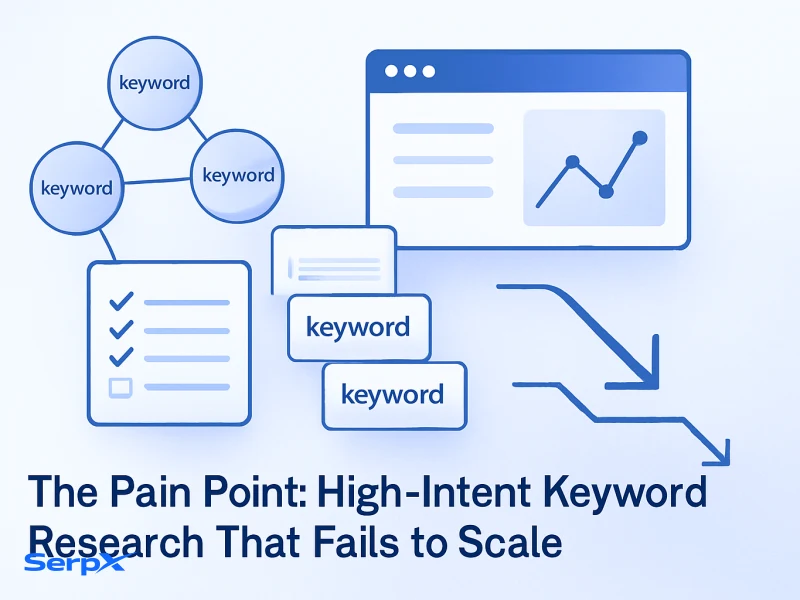
Many teams hit a wall when attempting to scale high-intent keyword discovery. Manual processes feel brittle: analysts chase a few obvious phrases, clients demand quick wins, and the data quickly becomes stale. The result is a keyword list that looks big but converts poorly, or worse, a backlog of ideas that never make it into briefs because the workflow is too slow for sprint cycles.
In practice, teams wrestle with two core problems: first, finding the right signals that indicate purchase or action intent; second, turning those signals into actionable content briefs without sinking days into keyword hygiene. The working reality is this: you need a repeatable, auditable workflow that respects human judgment while exploiting scalable automation. That’s where LLMs (large language models) enter as a practical complement—not a black-box replacement.
- Pain point examples: a SaaS startup chasing high-intent terms near the bottom of the funnel, or an ecommerce team trying to surface product-specific queries tied to buyer intent.
- Typical misstep: assuming tools alone can surface intent signals without a curated process or clear prompts.
For context, see how other teams are combining AI-assisted workflows with human review in our guide on AI-driven optimization and process design AI SEO strategies for competitive niches 2026.
What Counts as High-Intent Keywords?
That matters because
High-intent keywords are those that signal a likelihood of conversion, renewal, or direct action. They often fall into transactional or commercial categories, include precise product or service terms, or reflect imminent decision-making. Key signals include explicit purchase language, long-tail specificity, and intent modifiers like “best,” “vs,” “pricing,” or “demo.”
To avoid chasing vanity metrics, balance search volume with intent strength, historical conversion data, and content feasibility. A keyword that looks valuable on volume alone can underperform if users aren’t ready to convert on your page type or geography. A practical way to frame this is: define high intent as keywords where your page can reasonably answer the user’s core question and satisfy their purchase or action objective within a single session.
Practical examples: “enterprise pricing for CRM platform,” “best AI CRM for mid-market,” “where to buy X product in US,” or “Product X vs Product Y demo.” If your product pages, pricing pages, or detailed comparison guides can be ranked for these queries and drive qualified clicks, you’re operating in high-intent territory. A helpful reference when building your taxonomy is the broader keyword research guidance available here: Keyword Research Guide: High-Value Keywords.
Designing a Practical LLM-Driven Keyword Research Workflow
Think of LLMs as a force multiplier for your existing research funnel. The goal is not to replace analysts but to accelerate the stages where human judgment is essential: screening signals, validating intent, and turning findings into briefs. Here’s a lean, repeatable workflow you can implement this week.
- Seed collection: Start with seed keywords from your product pages, support queries, and competitor research. Feed a compact list into the model to surface related terms, queries, and intent variants.
- Prompt design: Build prompts that explicitly request intent classification, clustering hints, and content format recommendations (blog posts, product pages, FAQs). Don’t rely on a single prompt—iterate with 2–3 variants per task.
- LLM-assisted screening: Use the model to classify keywords by intent (informational, navigational, commercial, transactional) and by topic cluster. Use guardrails to prevent mislabeling and to flag edge cases for human review.
- Validation against data: Cross-check model outputs with historical performance data (CTR, time on page, conversion rate). Tag keywords with a confidence score to guide prioritization.
- Brief generation: For each cluster, generate a concise content brief, target intent, suggested page type, and suggested H1/H2 framing. Export briefs to your content calendar or CMS.
- Quality control: Run a quick human check on a sample of prompts and outputs to catch drift, bias, or hallucinated terms. Maintain a versioned checklist for repeatability.
In practice, you’ll use SerpX’s AI-driven capabilities to streamline steps 2–4, then overlay your own product and market signals in step 5. For a concrete example of how to structure prompts and guardrails, see How to Use AI for Keyword Research in 2026.
Accelerate your workflow with our AI SEO Tools suite. Start with AI SEO Tools for seed prompts and clustering templates.
Interested in automation with guardrails? Check Keyword Gap Tool and Competitor Keyword Research Tool to align your prompts with real-world gaps.
What to do next: map a 2-week sprint around implementing the workflow for a single product line and measure how quickly you can surface 40–60 high-potential keywords with clear intent signals. If you’re unsure where to start, see how SerpX compares to other platforms in our in-depth tool comparisons SerpX vs Ahrefs.
LLM-Based Clustering and Prioritization for Targeted Content
This becomes a problem when
Once you have a broad set of high-intent candidates, you need to cluster them into topics that inform coherent content programs. LLMs excel at semantic grouping, but quality hinges on prompts and guardrails. The aim is to reduce cognitive load for writers while preserving nuance in intent signals.
Two practical approaches work well in tandem:
- Topic-centric clustering: group by user need (e.g., pricing, setup, troubleshooting) and by funnel stage (awareness vs. evaluation vs. conversion).
- Merchant intent weighting: assign higher priority to terms that align with your strongest conversion signals and existing product messaging.
To help you compare approaches quickly, here is a concise table that contrasts typical strategies and their trade-offs.
| Approach | Pros | Cons | Best For |
|---|---|---|---|
| LLM-driven clustering | Scales to large datasets; captures semantic nuance; quick re-clustering as signals evolve | Prompts can drift; requires human review for edge cases | Large sites with evolving content strategy |
| Seed-driven categorization (manual plus AI) | Higher control; integrates business priorities | Time-intensive upfront; slower when data grows | Small-to-mid sites needing precise taxonomy |
| Hybrid scoring (AI + data signals) | Balanced accuracy; direct tie-ins to conversion data | Requires data integration effort | Programs aiming for measurable ROI |
Whichever path you choose, keep a simple scoring sheet: intent confidence, topic fit, content feasibility, and expected impact. Then convert clusters into content briefs with clearly defined deliverables.
As you implement, consider sourcing examples from these related reads: Automated keyword clustering for large-scale websites and Keyword Research Guide: High-Value Keywords.
To explore practical clustering tools and workflows, see our post on Scaling Content Production Using AI SEO Tools.
Need a quick win? Try the Keyword Gap Tool to surface gaps within your clusters and prioritize content ideas.
What’s next: create a 6-week content calendar that maps cluster topics to product pages, blog posts, and FAQs. Then measure impact with page-level conversion data and ranking velocity.
Guardrails, Trade-offs, and Risk Management
AI-assisted keyword research is powerful, but it isn’t perfect out of the box. Hallucinations, prompt drift, and inconsistent quality are real risks. A disciplined approach includes guardrails that keep outputs aligned with business goals and user intent.
- Human-in-the-loop: Schedule quick review passes on every cluster before it feeds into briefs. A five-minute sanity check beats a production error.
- Versioned prompts: Track prompt variants and outcomes so you can revert when a prompt starts drifting.
- Data-backed validation: Cross-check LLM outputs against historical performance data and current SERP features.
- Geography and language guardrails: Filter prompts by region and language to avoid irrelevant results.
Trade-offs are inevitable. If speed is your priority, you’ll accept a tighter review process. If accuracy matters more, build a heavier QA layer and longer iteration cycles. In practice, aim for a 70/30 balance: 70% speed with guardrails, 30% human refinement.
For a rigorous audit framework, many teams start from the AI-powered Technical SEO Audit Checklist and adapt it for keyword research workflows AI-Powered Technical SEO Audit Checklist.
One practical warning: avoid over-reliance on a single source of truth. Combine model outputs with your analytics, historical data, and qualitative feedback from sales and customer success to keep your keyword program grounded.
SerpX Workflow: How to Implement This Tonight
One thing many teams miss:
SerpX can operationalize this approach with a practical, repeatable cadence. Here’s a lean implementation you can run in under a day, then scale over weeks.
- Seed with intent-minded prompts: Start with 20–40 seed terms (product pages, competitor phrases, common support questions). Ask the model to classify intent and propose 5 related terms per seed.
- Cluster and scoring: Use AI to cluster terms into topical groups and assign a confidence score for each cluster based on intent signals and historical performance.
- Prioritize content opportunities: Rank clusters by impact potential (conversion signal, funnel stage) and feasibility (content gaps, page ownership).
- Generate briefs and templates: For each cluster, create a work-back brief with recommended content type, H1/H2 framing, and quick outline to speed writing.
- Review and publish: Run a lightweight QA pass and assign briefs to writers. Track outcomes to refine prompts and scoring rules.
- Measure and iterate: After publishing, measure engagement, on-page time, and conversions. Feed results back into your seed data to improve prompts.
For deeper workflow guidance and best practices, explore our AI-driven optimization content and tool comparisons SerpX vs Ahrefs.
Jumpstart your SerpX workflow with AI SEO Tools and disciplined prompts tuned for high-intent signals.
Want to verify outputs with data? The Backlink Checker and Competitor Keyword Research Tool provide a reality check on competitive landscapes.
Final nudge: if you’re evaluating tool stacks, see how SerpX stacks up against alternatives in our tool comparison posts and choose a path that matches your growth plan. SerpX vs Semrush offers a clear starting point.
Ready to implement? See pricing or Register to start a trial.
Checklist: Set Up Your LLM-Driven Research (24-Hour Plan)
- Define objective: determine which product areas or campaigns will be prioritized for the next 90 days.
- Assemble seed keywords: 20–40 items drawn from product pages, support queries, knowledge base searches, and competitor terms.
- Design prompts: craft 2–3 prompts per task (intent classification, clustering, and brief generation) and test on a small batch.
- Run a quick AI pass: generate candidate clusters, intent labels, and briefs; tag outputs with confidence scores.
- Human QA: review 10–15% of results for accuracy, adjust prompts if necessary.
- Prioritize and brief: convert top clusters into briefs with content formats and delivery owners.
- Publish and monitor: launch content or optimizations; set up dashboards for ranking velocity and conversions.
- Iterate weekly: refresh seeds, adjust prompts, and re-prioritize based on performance data.
Tip: keep a running log of prompt variants and outcomes so you can reproduce successful configurations. For a recent hands-on reference, see Keyword Research Guide: High-Value Keywords.
Common Mistakes to Avoid
This becomes a problem when
- Relying on a single prompt or tool without human QA.
- Poor prompt hygiene: vague instructions, missing intent definitions, or inconsistent labeling.
- Ignoring historical performance data when validating outputs.
- Over-clustering to create overly granular topics that fragment the content plan.
- Failing to incorporate geography, language, or product-market fit signals.
- Publishing briefs without a concrete measurement plan for ranking and conversions.
What to do instead: implement a lightweight QA loop, version prompts, and tie outcomes to actual metrics. If you want a broader QA framework, check our AI-powered audit checklist for technical SEO (you’ll find practical parallels) AI-Powered Technical SEO Audit Checklist.
As you run these checks, keep in mind that less can be more: a handful of high-quality, well-defined keywords with clear intent signals often outperform longer, unfocused lists.
Frequently Asked Questions
What exactly counts as a high-intent keyword?
Keywords that reflect a likelihood of action, like purchasing, requesting a quote, or requesting a demo. They often include product names, comparisons, pricing terms, or problem-solving phrasing that signals readiness to move forward.
Can LLMs replace human reviewers in keyword research?
No. They accelerate discovery and initial sorting, but human judgment remains essential for validation, creative alignment, and final prioritization.
How do you guard against model hallucinations?
Use a human-in-the-loop for critical outputs, add confidence scores, and validate with historical data and actual SERP results. Regularly audit prompts and results.
What prompts tend to work best for keyword research?
Prompts that explicitly define intent categories, request clustering by topic and funnel stage, and require deliverables like content briefs. Iterate prompts based on feedback and outcomes.
How should I measure success?
Track ranking velocity for target keywords, on-page engagement, and downstream conversions. Use a simple dashboard that ties keyword clusters to specific content outcomes.
Where does SerpX fit into this workflow?
SerpX serves as the automation backbone for seed generation, clustering, and brief creation, while your team provides validation, optimization, and strategic decisions. See our workflow guidance and tool integrations in related posts.
Ready to implement a scalable, high-intent keyword research process? Explore SerpX pricing and start a free trial today: Pricing or Register.
Apply these ideas with SerpX tools
Turn insights into action with practical workflows for keyword research, competitor analysis, backlink review, and SEO planning.