AI-Powered Technical SEO Audit Checklist: A Practical Guide
A practical, step-by-step AI-powered technical SEO audit checklist to identify critical issues, prioritize fixes, and accelerate crawlability and indexing.
AI-Powered Technical SEO Audit Checklist: A Practical Guide
You're staring at a crawl error report and wondering which issues actually move rankings. Your site has crawl budget waste, indexation gaps, and inconsistent structured data. The problem isn’t data scarcity—it’s noise and a broken, inconsistent process. The solution is a repeatable, AI-assisted audit that surfaces high‑impact issues, assigns owners, and fits within your sprint cycles. This guide delivers a practical AI-powered technical SEO audit checklist you can implement this quarter, with real‑world examples and SerpX workflows.
In this post you’ll learn how to set up the audit, run it with SerpX tools, and translate findings into prioritized fixes. We include a ready-to-use checklist, a quick comparison table, and a concrete workflow you can replicate for any site launch or migration.
What is an AI-powered technical SEO audit?
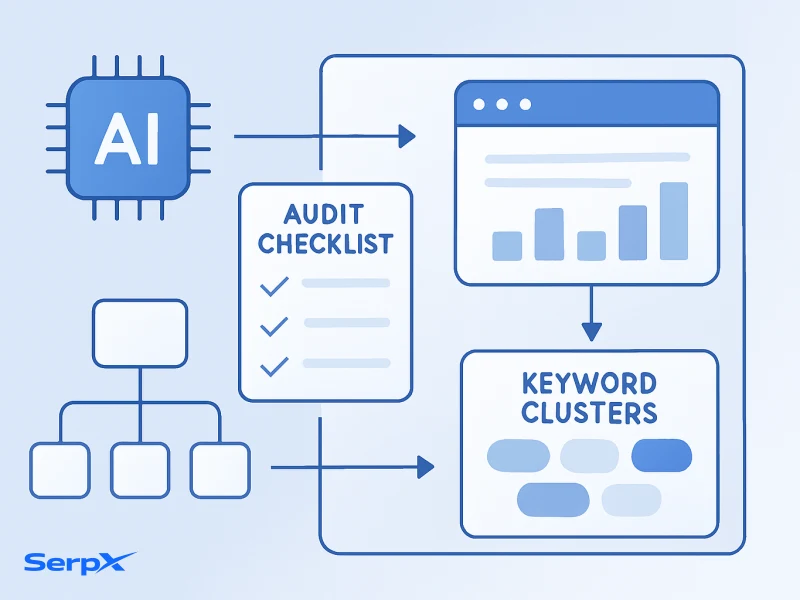
Think of it as a structured, data‑driven health check for your site where AI combs through crawling data, indexing signals, performance metrics, and structured data patterns to surface root causes and predict potential ranking impact. It’s not magic; it’s a disciplined process that scales. AI helps you triage issues—prioritizing quick wins (like broken internal links) and long‑term bets (like missing structured data) based on likely impact and effort.
For context, AI‑powered SEO concepts sit at the intersection of keyword intent, technical signals, and automation. If you want a broader framework, see our guide on What Is AI SEO. The practical benefit is a repeatable workflow you can run on a cadence, rather than a single one-off audit.
Audit at a glance: the AI-powered checklist
This becomes a problem when
Below is a compact view you can print or paste into a doc. It’s intentionally concise but actionable. The goal is to surface issues that business stakeholders care about—crawl budget, indexation quality, and data integrity.
| Audit Area | Manual Approach | AI-Enhanced Approach | SerpX Focus |
|---|---|---|---|
| Crawling & Indexing | Scan for 404s, canonical misalignments, and robots rules | AI flags crawl budget waste, conflicting signals, and indexability anomalies | AI-driven crawl maps highlight highest-priority fixes |
| Site Architecture | Review silo structure and depth manually | AI suggests structural refactors and internal linking patterns | Automated recommendations for hierarchical restructuring |
| Performance & CWV | Run speed tests; collect metrics | AI correlates content changes with CWV shifts | Unified performance signal dashboard |
| Structured Data | Validate schema with validators | AI detects missing types and incorrect values across pages | Schema recommendations and auto-check rules |
Tip: keep the table as a living artifact. In practice, you’ll add rows for new templates, migrations, or product launches. If you want a practical companion, explore our Technical SEO Guide for deeper procedures on those topics.
Soft CTA: Accelerate audits with SerpX AI-powered tools. Explore AI SEO Tools
Core sections of the AI-powered audit
Crawling health and indexation
Ensure all important pages are reachable and indexed. Check for disallowed URLs, noindex flags, and inconsistent canonical tags. Action: run a crawl, then use AI to classify pages by priority (critical pages, high‑traffic pages, product pages). For guidance, see our Technical SEO Guide.
Site architecture and internal linking
Review depth and silo integrity; AI can identify orphaned pages, dead‑end paths, and over‑optimized clusters. Action: propose re‑structuring and re‑linking opportunities. Use AI‑driven insights from our keyword gap analysis to identify missing internal linking opportunities: Keyword gap analysis.
Performance and Core Web Vitals
AI models correlate page changes with LCP, CLS, and TBT. Action: bucket pages by CWV risk and create a prioritized list of fixes. See how automation helps with content assets in AI content optimization.
Structured data and schema
Audit for required types and consistency. AI can recommend schema types for product, article, FAQ, and breadcrumbs. Action: implement schema and re‑check with validators.
Content quality and duplication
Identify near‑duplicate content and thin pages. AI can surface optimization opportunities and redirect or consolidate pages. For strategy guidance, read Keyword gap analysis.
Robots, sitemaps, and crawl directives
Validate sitemap submission, robots.txt rules, and crawl directives. If you want a concrete side‑by‑side on automation versus traditional tools, check our SerpX vs Semrush comparison.
AI-powered audit checklist (What to do now)
That matters because
- Define the audit scope and success metrics with the business owner. Clarify target pages, regions, and languages.
- Run a full site crawl and map the crawl budget against pages with the highest impact (e.g., core product pages and top landing pages).
- Check indexation status in Google Search Console and compare with your crawl results to identify indexing gaps.
- Validate canonical tags and ensure no conflicting canonical signals across silos.
- Identify 404s, 5xx errors, and broken internal links; plan fixes and ownership for the sprint.
- Verify robots.txt and sitemap correctness; ensure only allowed pages are crawled and indexed.
- Review site structure and internal linking; remove orphan pages and improve silo integrity.
- Assess Core Web Vitals impact, prioritizing pages with high traffic and revenue potential.
- Audit structured data for completeness and accuracy; fix missing or incorrect types across important pages.
- Check for content duplication or thin content; plan consolidation or upgrading strategies.
- Validate crawl directives for new launches or migrations; document any needed changes.
- Summarize findings into a remediation plan with owners, deadlines, and success metrics.
If you want practical guidance on implementing these steps with SerpX, pair this checklist with the Keyword Gap Tool to surface internal linking opportunities and content gaps: Keyword Gap Tool.
Common mistakes to avoid
- Running audits in isolation from business goals; always tie fixes to revenue or user experience improvements.
- Relying on a single tool or a single data source for critical decisions.
- Treating AI findings as final without human validation or stakeholder sign‑off.
- Overfixing low‑impact pages at the expense of high‑impact assets.
- Skipping regression checks after implementing fixes, causing repeated issues.
SerpX workflow: practical implementation
This becomes a problem when
Use this sequence to run the audit in a real project, with concrete actions at each step.
- Set scope and assign owners for each major area (crawl, indexation, CWV, schema).
- Run an AI‑assisted crawl with SerpX to surface high‑priority issues. AI SEO Tools can automate discovery and triage.
- Review findings with the remediation plan and assign tasks to the right teammates.
- Cross‑verify fixes using the AI dashboards and re‑crawl relevant sections to confirm impact.
- Document repeatable steps and schedule monthly or quarterly audits to detect drift early.
Soft CTAs to support this workflow:
Try Free SEO Tools for a quick sanity check during onboarding: Free SEO Tools
Need deeper gap insights? Run the Keyword Gap Tool to uncover opportunities: Keyword Gap Tool
For a full AI‑driven workflow, explore AI SEO Tools and scale your audits.
Finally, if you’re evaluating tool stacks or considering a move, see our comparison pieces like SerpX vs Semrush to understand how SerpX positions automation and data quality in practice.
Frequently Asked Questions
Frequently Asked Questions
In real workflows,
What exactly is an AI-powered technical SEO audit?
An audit that uses AI to analyze crawling, indexing, performance, and schema signals at scale. It surfaces high‑impact issues, estimates potential ranking impact, and helps prioritize fixes for sprints. Human oversight remains essential for strategic decisions.
How often should you run this audit?
For most sites, a cadence of monthly to quarterly works well. Migrating sites or high‑change environments may require more frequent checks or triggered audits after major updates.
What tools are essential?
A solid AI‑assisted crawler, a strong schema validator, and a dashboard to monitor changes over time. In SerpX terms, combine AI SEO Tools with a gap analysis workflow to surface opportunities.
Can AI replace human audits?
No. AI accelerates discovery and pattern recognition; humans diagnose business impact, validate fixes, and communicate changes to stakeholders.
How do you measure success after an audit?
Track indexation stability, ranking movements for target pages, crawl efficiency, and CWV improvements. Use a before/after comparison and monitor drift over time.
What’s the biggest mistake teams make with AI audits?
Treating AI findings as gospel without validation, lacking owners, or failing to integrate fixes into a sprint cycle. Iterative verification is essential.
Related Articles
Ready to implement this at scale? See SerpX pricing today and start a plan that fits your team: Pricing.
Apply these ideas with SerpX tools
Turn insights into action with practical workflows for keyword research, competitor analysis, backlink review, and SEO planning.